irene trujillo villegas


SILLA LUNA / SILLA SOL Forged iron, paint, wood, linen, rubber, silver, cultivated pearl, acrylic, glass, nuts and bolts. Dimensions: 104 x 83 x 50 cm
2024
ES
Silla Luna y Silla Sol constituyeron el punto de partida para A la hora que tú me digas, un proyecto colaborativo desarrollado junto a Andrea Perales Covarrubias. A lo largo de un año, exploramos estrategias de creación a distancia y modos de sostener vínculos afectivos y productivos entre Oaxaca (México) y Barcelona (España).Las sillas hacen referencia a las antiguas sillas-teléfono, diseñadas exclusivamente como lugares para la comunicación. En este caso, Silla Luna y Silla Sol simbolizan la diferencia horaria que atravesó todo el proceso, convirtiéndose en metáfora de la sincronización afectiva y del esfuerzo por mantener viva la amistad y el diálogo creativo.La propuesta se articuló como una investigación sobre la simultaneidad, la espera y la fragmentación, en la que el hacer se convirtió en un ejercicio de escucha expandida y atención situada. A través de objetos, acciones y correspondencias, se construyó un espacio relacional que trascendió la geografía, proponiendo formas de cohabitar desde la distancia y el afecto.
EN
Silla Luna and Silla Sol marked the starting point for A la hora que tú me digas, a collaborative project developed alongside Andrea Perales Covarrubias. Over the course of a year, we explored strategies for remote creation and ways to sustain affective and productive bonds between Oaxaca (Mexico) and Barcelona (Spain).
The chairs reference the old telephone chairs, designed exclusively as spaces for communication. In this case, Silla Luna and Silla Sol symbolize the time difference that shaped the entire process, becoming a metaphor for affective synchronization and the effort to keep friendship and creative dialogue alive.
The proposal unfolded as a research inquiry into simultaneity, waiting, and fragmentation, where making became an exercise in expanded listening and situated attention. Through objects, actions, and correspondences, a relational space was built that transcended geography, proposing ways of cohabiting through distance and affection.

A La Hora Que Tú Me Digas

To weave, one needs a loom: a firm base that holds the constant tension between all parts, and care in each thread to avoid rupture. Once completed, the interlaced threads create warmth and shelter. A textile, in more than one sense, becomes both a metaphorical and physical representation of the systems of care and support that run through our lives.
A la hora que tú me digas brings together individual and cumulative results by Andrea Perales Covarrubias and Irene Trujillo Villegas. Using found and captured materials from their everyday environments, the works created by both artists propose a visual diary, nurtured over years of shared time, as a habitual practice. This practice generates new ways of thinking about the everyday, raising questions such as: How can the act of sharing bread be sustained over time? How can the passage from public space to intimacy through a doorway be immortalized? How can a drop of rain be shared?
In this way, the collected and generated objects, images, and moments are interwoven with memories and gestures that together create poetic sites, capable of transforming the mundane into the extraordinary. The turning point that led them to work and collaborate was the act of creating at a distance: together but far apart, alone but not lonely. While their practices are notably different, they share a common understanding, humor, and sensitivity toward what surrounds them. The idiosyncrasies of Perales and Trujillo’s works form conversations, materializing intimate visual narratives that resonate with one another.
The exhibition brings together individual and collaborative works. Both artists invite the viewer to see through their eyes—individually and jointly. In this way, the exhibition space becomes a site for building community and shared care. For Andrea and Irene, “seeing is key in our distinct visual practices, and also becomes a starting point for how we experience our surroundings.”
Text by M. Lizcano
Para hacer un tejido se necesita un telar: una base firme que sostenga la tensión constante entre todas las partes, y cuidado en cada hilo para evitar la ruptura. Una vez completado, los hilos enlazados crean refugio y calor. Un tejido, en más de un sentido, se convierte en una representación tanto metafórica como física de los sistemas de cuidado y apoyo que atraviesan nuestras vidas.
A la hora que tú me digas reúne resultados individuales y acumulativos de Andrea Perales Covarrubias e Irene Trujillo Villegas. Utilizando materiales encontrados y capturados en sus entornos cotidianos, las obras realizadas por ambas artistas proponen un diario visual nutrido a lo largo de los años compartidos, como una práctica habitual. Esta práctica genera nuevas formas de pensar la cotidianidad, arrojando preguntas como: ¿cómo sostener en el tiempo el acto de compartir el pan?, ¿cómo inmortalizar el paso de lo público a lo íntimo al cruzar una puerta?, ¿cómo compartir una gota de lluvia?
Así, los objetos, imágenes y momentos recolectados y generados se entrelazan con recuerdos y gestos que, en conjunto, crean sitios poéticos capaces de transformar lo cotidiano en extraordinario. El punto de inflexión que dio lugar a esta colaboración fue el acto de crear a distancia: juntas pero lejos, solas pero no solitarias. Aunque sus prácticas son notoriamente distintas, comparten un mismo entendimiento, humor y sensibilidad hacia lo que las rodea. Las idiosincrasias de las obras de Perales y Trujillo forman conversaciones, materializando narrativas visuales íntimas que resuenan entre sí.
La muestra reúne obra individual y colaborativa. Ambas artistas invitan al espectador a mirar desde sus ojos, tanto de manera individual como conjunta. Así, el espacio de exhibición se presenta como un lugar para la construcción de comunidad y de cuidado compartido. Para Andrea e Irene, “ver es clave en nuestras distintas prácticas visuales, y se convierte también en un punto de partida para experimentar el entorno”.
Texto por M. Lizcano


PAISAJE SOLEADO
Steel, electrostatic paint, acrylic print, silkscreen, mahogany wood, ash wood, iron, copper, Oaxacan green quarry, piece of sponge, eye and hook turnbuckle, aluminum, brass. Dimensions: 153.5 x 115 x 38 cm.
Piece in collaboration with Andrea Perales Covarrubias.
Photo credits: El Arenero.
SERVILLETA, PEZ, LINO
Graphite, color pencil and oil on recycled paper and flyleaves, linen fabric, pen, paper, eyebolt, fish hook.
Piece in collaboration with Andrea Perales Covarrubias
Photo credits: El Arenero.
AQUELLO DE COMPARTIR EL PAN
Ceramic, aluminum baguette casted with Oceane Jacob; woven textile on pedal loom by Contreras Martínez family; bread from Onno Lonchería.
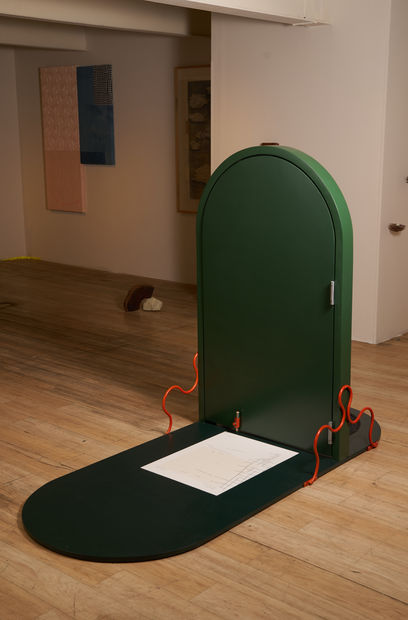


SÍGASE, BIEN PUEDA
Metal, paint, crayon, brass pedal, oak door fabricated by Constructora Perales de Matamoros silkscreen printed by Daniel Hernandez. 144 × 87.5 × 205 cm
Piece in collaboration with Andrea Perales Covarrubias.
Photo credits: El Arenero.
ES
Esta pieza funciona como la entrada al espacio que habitamos durante más de un año. Al abrirse, la puerta activa la impresión y deja una huella singular. Cada impresión de la serie (de 50) es activada por la persona que la recibe, estableciendo un vínculo directo entre el gesto y la obra. Al hacerlo, esa persona se convierte en coautora de la pieza, participando en su construcción.
EN
This piece functions as the entrance to the space we inhabited over the course of more than a year. When opened, the door activates the print and leaves a singular trace. Each print in the series (of 50) is activated by the person who receives it, establishing a direct link between gesture and artwork. In doing so, that person becomes a co-author of the piece, participating in its construction.